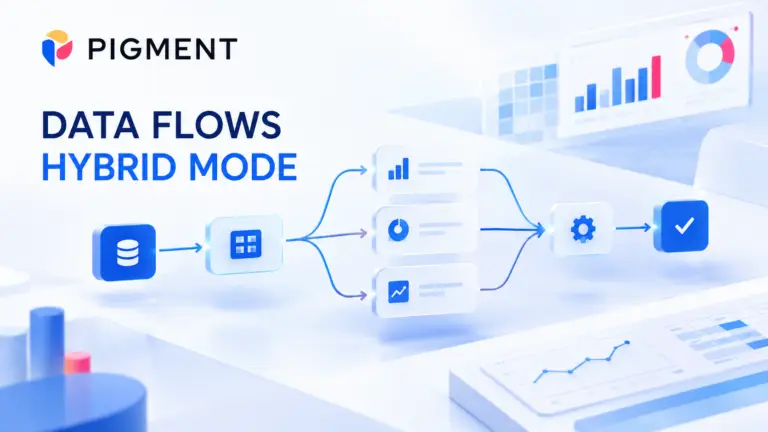
Implementing an EPM solution can require several months of work before producing its first tangible results. With Pigment Stencil, Pigment is introducing a new AI-driven deployment methodology designed to accelerate the development of planning applications, facilitate testing and enable teams to validate their choices earlier in the project. The vendor announces a reduction in timelines of up to seven times.
A new approach to EPM projects
Traditional EPM deployments often rely on a sequence of steps: requirements gathering, specification writing, model design, development, testing and validation. This process can take six to eighteen months, particularly when migrating from existing tools.
For Pigment, this organization has several limitations. Requirements can sometimes be difficult to translate into concrete features, teams depend heavily on specialist intervention, and errors are not always identified early enough. When users discover how their application actually works at a late stage, adjustments can result in additional costs and delays.
Pigment Stencil aims to address these challenges by integrating artificial intelligence throughout the implementation process. The goal is no longer merely to formalize requirements, but to quickly transform them into an operational, testable and documented application.
AI agents supporting implementation
The methodology is structured around three main stages. Business teams begin by defining their objectives during design workshops and validating prototypes. Pigment specialists and its partners then step in to guide the architecture, review the logic produced by AI and control the quality of the development work.
AI agents handle part of the construction, testing and documentation work. According to Pigment, seven Stencil agents, running with Claude Code and skills dedicated to its platform, support the different project phases under human supervision.
This approach is complemented by the Modeler Agent, integrated directly into Pigment. In particular, it can create metrics, formulas and dashboards within the client’s work environment.
By enabling users to interact with a functional model more quickly, Pigment aims to encourage earlier feedback and reduce the cost of corrections. Companies can also reassess their existing processes rather than systematically reproducing them in their new tool.
Avalara: an initial experience report
Among the first companies to adopt this methodology was Avalara, which specializes in tax compliance solutions. Its Pigment implementation project took place over sixteen weeks.
According to information provided by the vendor, the Modeler Agent completed approximately 90% of the initial build of a complex model covering several products and business segments.
This implementation enabled teams to review an operational model within the first few days and identify structural issues before they became costly to correct. The approach also facilitated user adoption, as users were able to compare the application with their actual needs more quickly.
The time saved notably enabled Avalara to prepare its new fiscal year on Pigment without having to maintain a full planning cycle in parallel on its legacy system. For the company, the expected benefits therefore relate as much to reducing manual work as to gaining faster access to the analyses required for decision-making.
Acceleration that still needs to be assessed project by project
With Pigment Stencil, the vendor is seeking to evolve EPM deployment practices by bringing requirements definition, application development and validation closer together. Pigment announces projects that can be completed two to seven times faster, but these gains necessarily depend on model complexity, the quality of the requirements expressed and how teams are organized.
The methodology does not eliminate the role of experts either: their involvement remains essential to guide technical choices, review the results generated by AI and ensure the application’s consistency.
Pigment also plans to publish the Stencil agents on GitHub during the month following the 29 October 2026 announcement. This opening is intended to provide greater insight into how they work and their contribution to the deployment process.
For companies considering a migration or seeking to modernize their financial planning, the challenge will now be to determine the extent to which this approach can reduce timelines and costs while improving the quality of EPM projects.
source: Pigment