Oracle Cloud EPM 26.11 brings several enhancements to the platform’s financial planning and analysis tools. New features include capabilities for explaining variances between forecasts and actuals, artificial intelligence-based assistants and the ability to explore data using natural language. Oracle is therefore strengthening the resources available to finance teams to analyze performance, access relevant information and better understand the factors influencing their results.
Better understanding variances to support decision-making
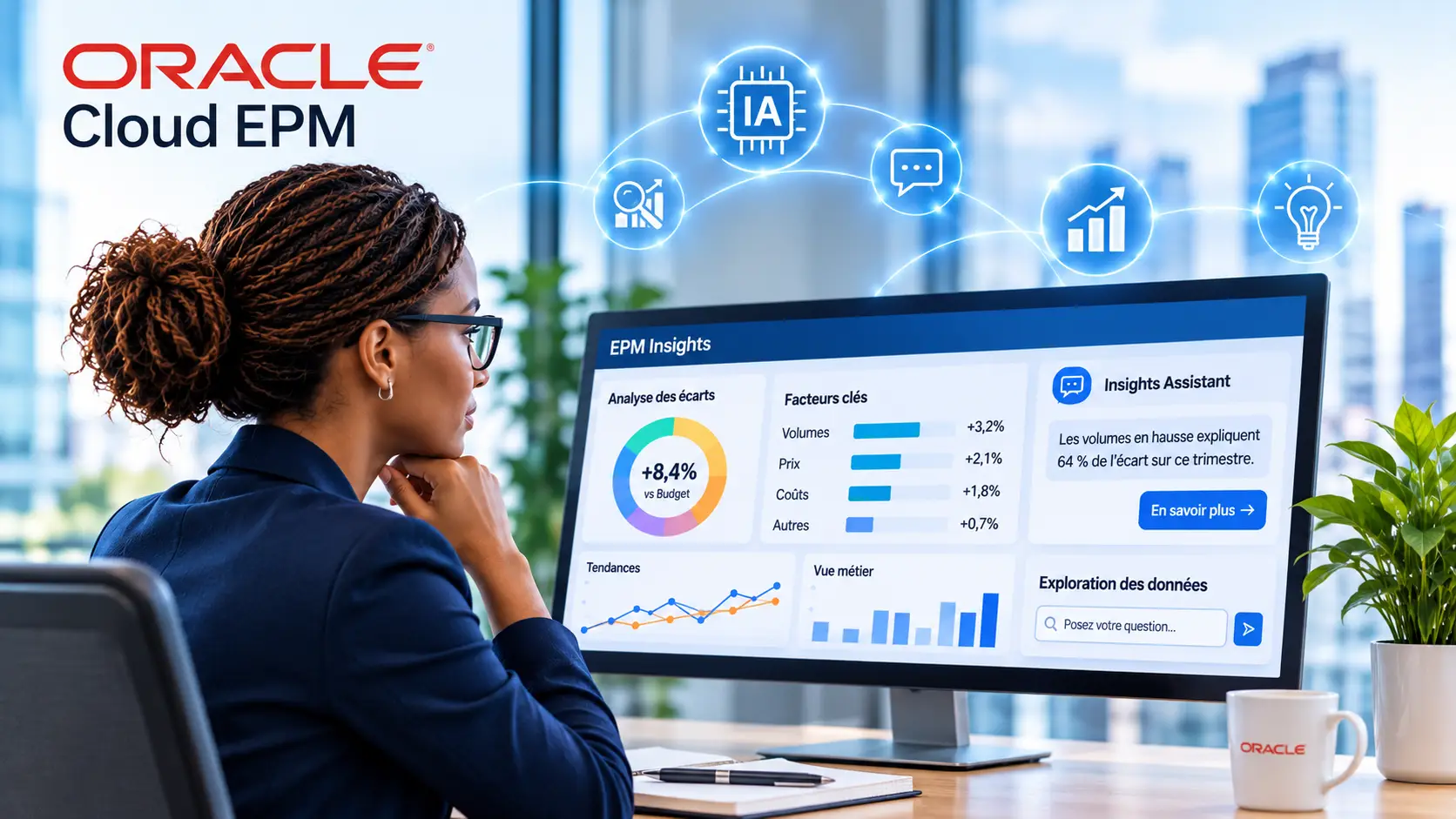
One of the main new features is Insights Analysis, designed to provide deeper analysis of financial variations. It identifies the main factors contributing to variances and breaks them down according to their effects on the company’s various performance drivers.
The aim is to go beyond simply identifying a variance between forecasts and actuals. For finance teams, the goal is to better understand the elements explaining a change, whether it is related to volumes, prices, costs or other operational factors. This more detailed view can facilitate discussions between finance teams and operational managers, particularly during budget review and forecasting exercises.
Oracle is also enhancing IPM Insights with a dedicated assistant. Integrated into Fusion AI Agent Studio, IPM Insights Assistant is based on a reusable workflow for retrieving, validating and presenting analyses. Companies therefore have a new way to structure the presentation of information and make it easier for users to leverage.
Analyses directly accessible from dashboards
Version 26.11 also makes it possible to display key insights directly in dashboards. Users can therefore find important information within their usual workspaces, without necessarily having to navigate between several features.
This enhancement comes with the launch of a new data exploration skill, called Data Exploration Skill. It enables users to query and explore data conversationally. Users can formulate requests in natural language to access the information they are looking for more easily.
This approach reflects a shift in EPM usage: users are no longer limited to consulting reports or manipulating data in predefined interfaces. They can gradually interact with their planning environment more directly.
Providing business context for data
The other notable enhancement concerns Business Concepts and semantic definitions. These elements associate business meaning with data and provide greater context to the systems that use it.
This aspect is particularly important with the development of artificial intelligence assistants and agents. To produce relevant analyses, they must be able to rely on definitions that are understandable and consistent with the company’s practices. The quality of interpretation therefore depends as much on access to data as on understanding its meaning.
A platform expanding its integration capabilities
Oracle is also evolving Cloud EPM’s technical capabilities. Version 26.11 notably announces 141 APIs dedicated to the platform, intended to support integrations and the development of customized skills.
New REST APIs complement this set, including APIs for accessing IPM Insights analysis details, managing dashboards, performing operations on data and administering connections. These enhancements provide more options for companies that want to connect their EPM environment to other applications and adapt certain processes to their needs.
The other modules also benefit from this update. Account Reconciliation notably gains new filtering capabilities with generative AI and additional APIs. Financial Consolidation and Close includes new assistants dedicated to consolidation rules and data diagnostics. Enterprise Profitability and Cost Management is also enhanced with its PCM assistant, while Narrative Reporting and Tax Reporting benefit from several improvements.
Financial management with greater AI assistance
With Oracle Cloud EPM 26.11, artificial intelligence plays a greater role in several stages of financial work: data exploration, variance identification, analysis presentation and the automation of certain interactions.
These enhancements form part of a broader transformation of EPM solutions. After gradually strengthening data collection, consolidation, planning and reporting capabilities, vendors are now seeking to facilitate the interpretation of information and its use in day-to-day decision-making.
However, the value of these new features will depend on their adoption by teams, the quality of the available data and their integration into existing processes. For finance departments, the challenge will therefore not simply be to have new intelligent assistants, but to determine how these capabilities can concretely improve the reliability of analyses and the responsiveness of management.
source: Oracle