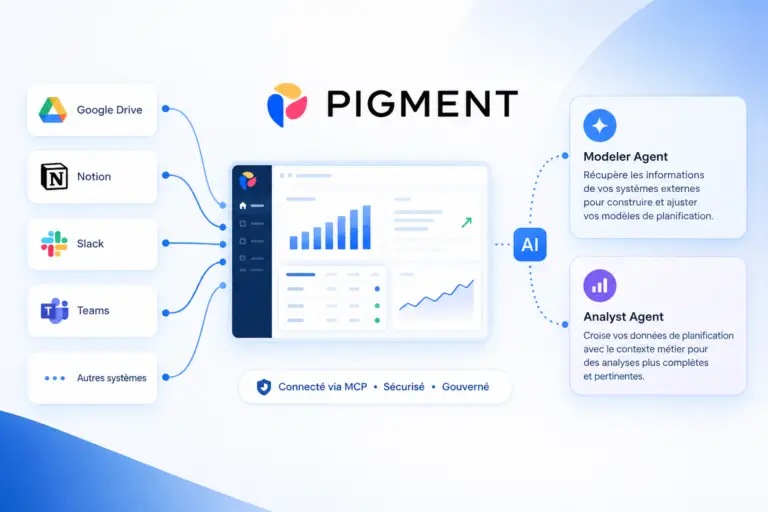
Pigment is enhancing the management of its data flows with a new automation capability via API. In an update published on September 8, 2026, the provider details the features that allow users to trigger a Data Flow, monitor its execution and identify any errors. This technical development directly concerns companies using Pigment for their planning and performance management processes.
Data Flows that can be controlled via API
In Pigment, a Data Flow makes it possible to group several Data Actions within the same configuration. These actions can notably be used to import data between different metrics or lists.
These flows can now be triggered via an API. The aim is to make it easier for companies to integrate Data Flow execution into their own automation processes or existing systems.
To launch a flow, the user must have an API key with the “Data Flows” authorization scope, as well as the identifier of the relevant Data Flow. A request can then be used to start the execution and retrieve a unique identifier associated with it.
More precise execution monitoring
The other development concerns operational monitoring. Once the Data Flow has been launched, its status can be viewed via a second API request.
Pigment distinguishes between four main situations: “InProgress” when processing is still underway, “Completed” when it has finished successfully, “PartialFailure” when at least one step has failed but the flow has reached its end, and “Failed” when execution has stopped following an error.
Each step also has its own status. Teams can therefore see which operations have been executed, which are still in progress and which have encountered an issue.
This level of granularity can be particularly useful in environments where multiple data sources must be synchronized before feeding a planning or reporting model.
An approach that strengthens EPM process automation
For finance teams, the main benefit lies in reducing manual interventions around data. A Data Flow can, for example, group several steps required to update a model and then be launched automatically from another system.
Pigment notably cites the example of a flow used to synchronize HR data with an FP&A environment. In this type of scenario, the API can be used to integrate the update process into an automated workflow.
The feature also provides greater visibility in the event of an incident. When a step fails, its import identifier can be used to retrieve a detailed report and determine whether the issue originates from the source data or the import configuration.
Permissions remain central to the process
Automation does not change the existing access rules. Pigment specifies that an API key inherits the permissions of the user who created it. This user must therefore be authorized to execute each of the Data Actions included in the Data Flow.
The provider also points out one limitation: Data Flows containing certain P2P actions that use selective mapping based on a Data Action parameter cannot be triggered with this API.
This clarification serves as a reminder that data flow automation must remain closely linked to access governance and model configuration.
A technical development for connected EPM environments
With this update, Pigment is primarily strengthening the integration capabilities of its platform. Data Flow triggering and execution monitoring can now be integrated more easily into automated processes.
For organizations seeking to connect their EPM environment to their data systems and limit manual operations, this development therefore provides a new orchestration option. It is part of a broader market trend: making EPM not only a planning tool, but also a component connected to the company's various data processes.
source: Pigment