In a context where financial and operational planning is becoming a strategic lever, companies are looking for solutions capable of combining agility, collaboration, and intelligent performance management. This Anaplan vs Pigment comparison highlights the strengths, limitations, and specific features of these two leading platforms to help CFOs and management controllers make an informed choice.
Vision and positioning: two approaches to the same objective
Anaplan, a pioneer in Connected Planning, has established itself as a leading global solution for large organizations. Its cloud platform connects strategic, financial, and operational planning across the enterprise.
For its part, Pigment, launched more recently, targets organizations looking for a more modern, intuitive, and collaborative solution. Its promise: to combine the power of a robust analytics engine with a smooth user experience inspired by the best SaaS tools.
| Criterion | Anaplan | Pigment |
|---|---|---|
| Positioning | Global Connected Planning tool | Modern unified planning and simulation solution |
| Target audience | Large international companies | Mid-sized and innovative large companies |
| Year founded | 2006 | 2019 |
| Origin | United States | France |
Modeling and technical performance
Anaplan is built on its Hyperblock engine, recognized for its computing power and ability to handle large-scale models. However, this architecture may sometimes require advanced technical expertise and a longer modeling phase.
Pigment, on the other hand, uses a high-performance in-memory calculation engine combined with an intuitive no-code/low-code interface. It facilitates the creation of dynamic models, real-time data integration, and instant scenario updates.
Pigment advantage: modeling speed and flexibility.
Anaplan advantage: proven robustness for very large data volumes.
Collaboration and user experience
Collaboration is a strength of both platforms, but they take different approaches.
-
Anaplan focuses on process centralization and consistency at scale.
-
Pigment emphasizes a modern user experience, with interactive views, customizable dashboards, and a smooth learning curve for non-technical users.
Finance managers appreciate Pigment’s clear visualization of dependencies and transparent calculations, while Anaplan appeals through its functional maturity and centralized governance.
Integration and connectivity
Anaplan integrates with a broad ecosystem (Salesforce, Workday, SAP, Oracle, Power BI, etc.) through Anaplan Connect and dedicated connectors.
Pigment also offers native integrations (Snowflake, BigQuery, Netsuite, Workday, Google Sheets, Power BI…) and a modern API that is often faster to configure.
Anaplan advantage: extensive connectivity recognized in complex environments.
Pigment advantage: seamless integration and a modern data approach.
Intelligence and predictive scenarios
Both solutions include advanced scenario planning and intelligent forecasting capabilities.
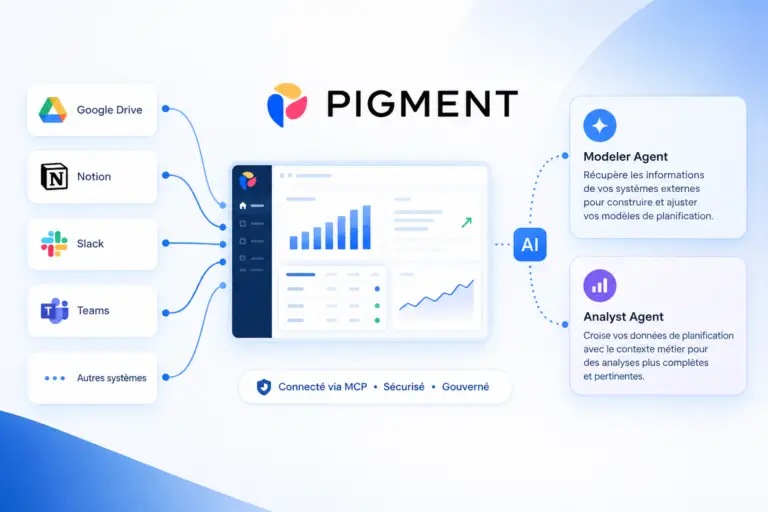
Pigment stands out through its instant visualization of impacts, the simplicity of creating “what-if” scenarios, and the modernity of its AI agents. Indeed, the AI agents developed by Pigment allow users to ask questions in natural language and receive instant answers about the figures recorded in the database. They can also build analyses and reports instead of developers.
Anaplan, for its part, offers in-depth AI and machine learning integration through partnerships and additional modules.
Costs and deployment speed
Anaplan’s licensing model is suited to large organizations, with costs proportional to the complexity and size of the models. Implementation can take several months.
Pigment offers faster implementation (often within a few weeks) and a gentler learning curve, appealing to finance teams seeking a rapid return on investment.
Pigment advantage: accelerated deployment and natural adoption.
Anaplan advantage: comprehensive solution for complex global environments.
In summary: two champions, two philosophies
| Key attribute | Anaplan | Pigment |
|---|---|---|
| Robustness |  |
|
| Intuitiveness | |
|
| Collaboration | |
|
| Deployment speed | |
|
| Scalability | |
|
| Best suited to... | Multinational groups | Agile and growing organizations |
Conclusion: a choice of maturity and vision
The Anaplan vs Pigment comparison shows that this is not about pitting two tools against each other, but rather two visions of modern planning.
-
Anaplan remains a safe choice for large international groups seeking an interconnected and highly governed planning platform.
-
Pigment appeals to dynamic finance teams looking for a more flexible, visual, and collaborative solution capable of adapting quickly to their needs.
Ultimately, the best tool will depend on your organization’s level of analytical maturity and your data culture. The key is to choose a solution that frees up finance teams’ time so they can focus on analysis, strategy, and value creation.