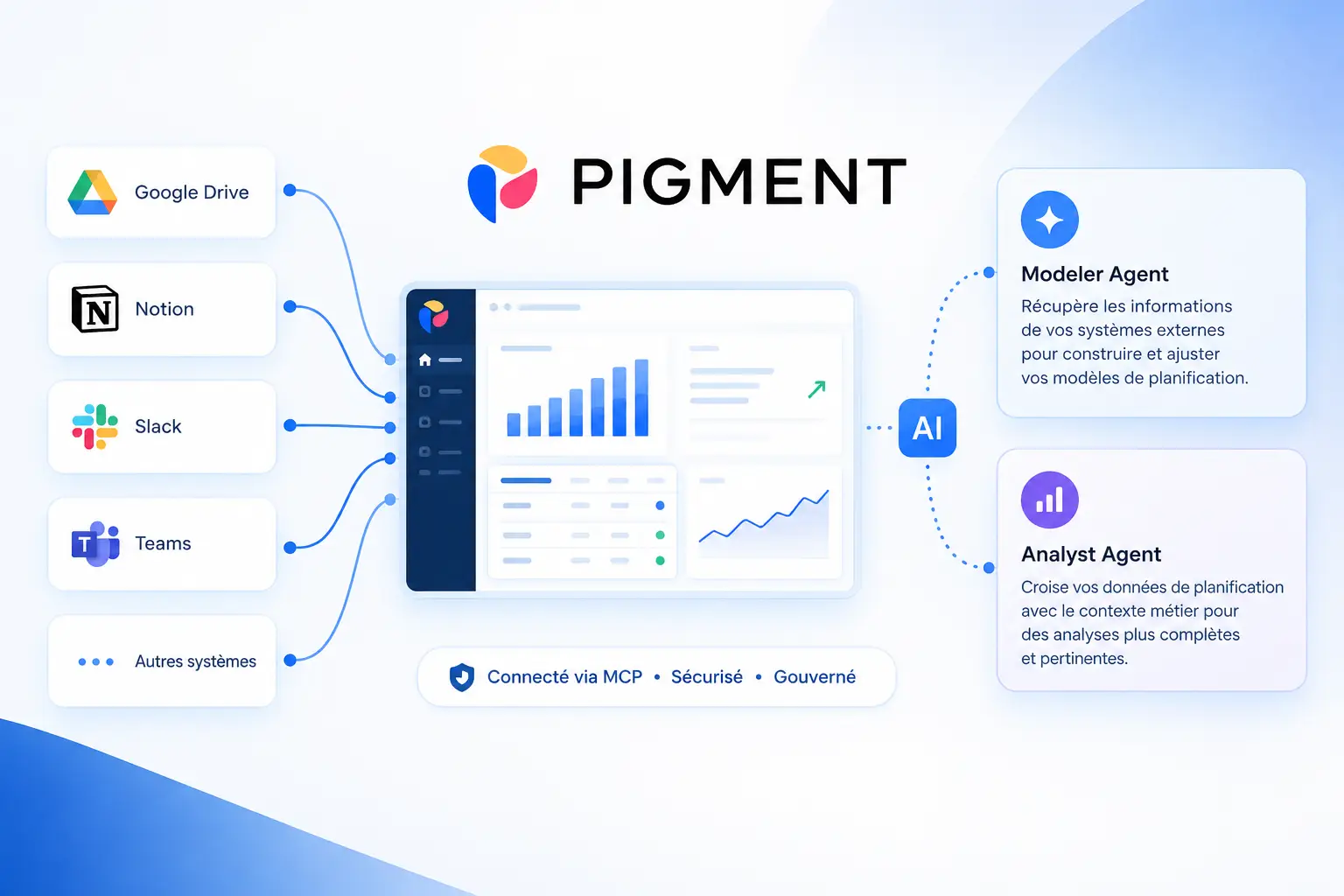
Pigment continues to develop its artificial intelligence capabilities with the launch of Agent Connectors, announced on September 17, 2026. This new feature enables the platform’s AI agents to access information directly from external systems through the Model Context Protocol (MCP). The objective is to give agents more context to support planning, analysis and performance management activities.
Information is becoming increasingly dispersed
In companies, the information required for planning is not always located in a single tool. Project requirements may be recorded in a document, assumptions in a Notion page, and the company’s objectives in a dedicated OKR workspace. Until now, users often had to retrieve this information manually before transferring it to a planning tool.
With Agent Connectors, Pigment aims to reduce this intermediary step. Its agents can now access external systems via MCP, a standard designed to enable AI applications to interact with external tools and information sources. Pigment notably states that this protocol is already used by tools such as Claude, Cursor and ChatGPT.
The Modeler Agent can retrieve the necessary context
One use case involves the Modeler Agent, Pigment’s agent for creating and modifying models.
Through Agent Connectors, it can retrieve information held in external systems and integrate it into a planning model. Pigment specifically cites the ability to retrieve staffing requirements from a Google document or supplier lead-time constraints from Notion and apply them to an inventory management model.
This approach is intended to prevent teams from manually reproducing information that is already available elsewhere in their work environment.
The Analyst Agent for cross-referencing multiple sources
The feature also applies to the Analyst Agent, which can use information from multiple systems to enrich its analyses.
For example, Pigment makes it possible to compare a recent forecast with OKRs recorded in Notion in order to identify potential variances. The agent can also combine performance data available in Pigment with feedback from Slack.
For finance and operations teams, the challenge is to analyze planning data while taking into account business context that is sometimes located outside the EPM platform.
A connection governed by MCP
Pigment also presents Agent Connectors as a way to centralize and govern connections between its agents and the various external systems. Connections pass through a controlled channel and remain linked to the planning data used in Pigment.
This aspect is important in a context where companies are seeking to expand their use of AI while maintaining control over data and exchanges between applications.
A new step for AI in planning
With Agent Connectors, Pigment is evolving the role of its AI agents toward use cases that are more closely connected to companies’ work environments. The objective is no longer merely to work with the information available on the platform, but to enable agents to retrieve the necessary context from other systems.
For users, this evolution could simplify certain model preparation and performance analysis tasks. It also illustrates a trend in EPM: progressively integrating agents capable of interacting with the company’s data, tools and business context.
Pigment states that Agent Connectors are intended in particular for its Modeler and Analyst Agents and invites users to discover these features during its upcoming demonstrations.
source: Pigment