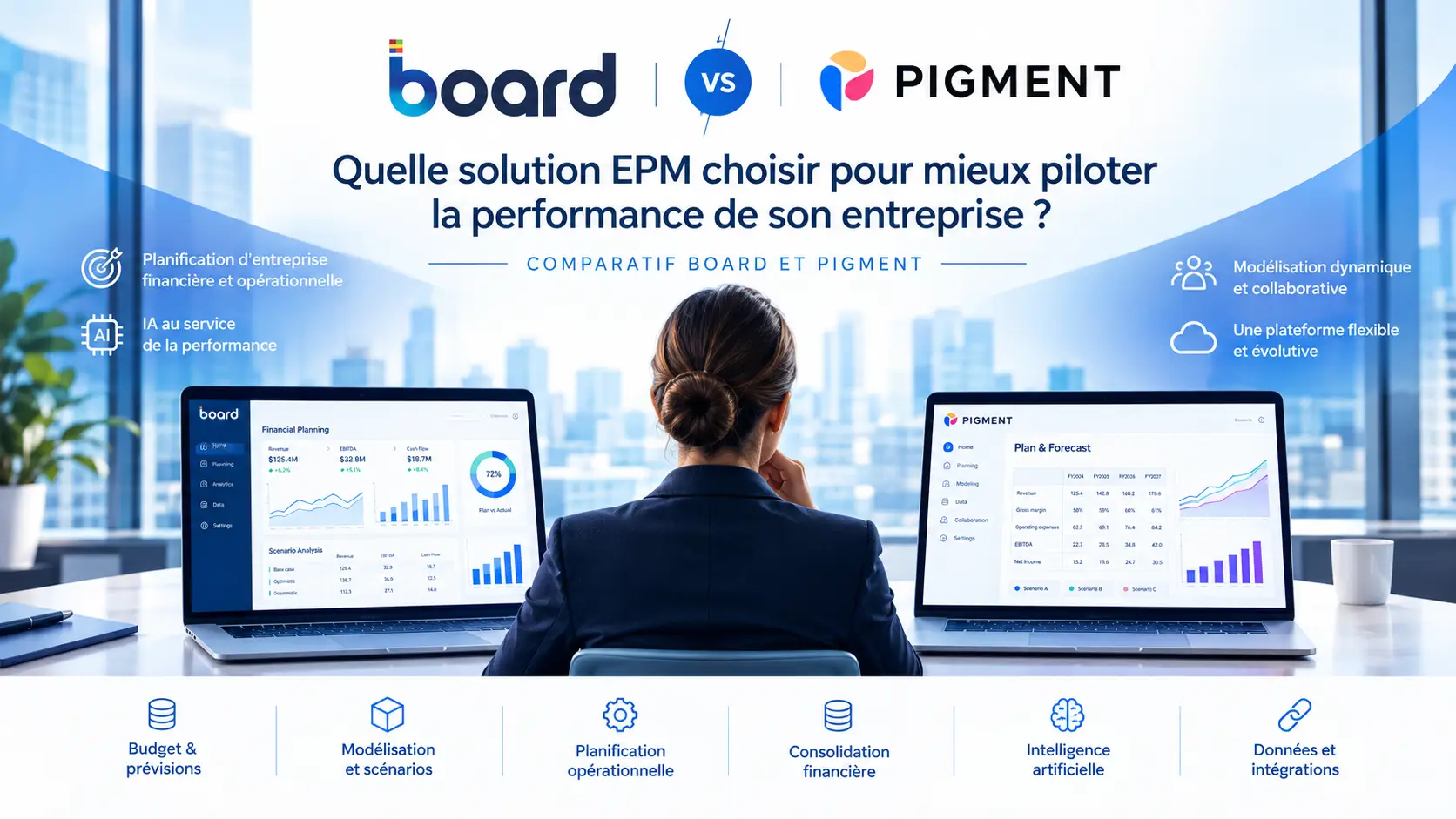
Finance departments today must build more reliable budgets, update their forecasts more regularly, and explain variances between expected and actual results. In many companies, this work still relies on Excel files, dispersed systems, and manual exchanges between departments. EPM solutions seek to address these challenges by connecting data, financial models, and decision-making processes. Board and Pigment are among the platforms designed to meet these needs. But what are their differences, which features should be compared, and how can an organization determine which one best suits it? This comparison examines their main characteristics to help finance departments make an informed choice.
Board and Pigment: two visions of enterprise planning
Board is now presented as an enterprise planning platform that combines data, financial and operational models, and artificial intelligence in a shared environment. Its offering notably covers financial planning, supply chain planning, workforce management, forecasting, and financial consolidation. The vendor emphasizes a continuous planning approach, in which companies can update their assumptions, simulate changes, and bring financial decisions closer to operational constraints.
Pigment positions itself as an integrated planning platform for finance and operations teams. It is built on a dynamic modeling engine, centralized data management, and collaborative features for building budgets, updating forecasts, and analyzing multiple scenarios. Its Graphite architecture, presented by the vendor in 2026, notably emphasizes model flexibility, data management, and the ability to evolve plans without rebuilding their entire structure. Pigment is also developing financial consolidation and artificial intelligence features.
Both platforms therefore seek to bring planning, analysis, and decision-making closer together. The difference is not simply an opposition between a traditional tool and a modern one. It must be found in how each solution responds to the company’s processes, the complexity of its models, its control requirements, and its organization.
Board and Pigment comparison: the main differences
The following table summarizes the documented directions of the two vendors. It is not a ranking: the available features, their depth, and their conditions of use must be verified according to the scope of the project.
| Criterion | Board | Pigment |
|---|---|---|
| Positioning | Financial and operational enterprise planning | Integrated planning and collaborative modeling |
| Budget and forecasting | Financial planning, forecasting, and scenario analysis | Budgeting, forecasting, and dynamic scenarios |
| Modeling | Multidimensional engine and planning models | Dynamic modeling and evolving structures |
| Operational planning | Coverage of supply chain, commercial activities, and workforce | Coverage of sales, workforce, demand, and other business processes |
| Financial consolidation | Dedicated consolidation and financial reporting offering | Consolidation offering integrated into financial planning |
| Artificial intelligence | Analytical and generative AI, and agents dedicated to planning and financial processes | Agents for analysis, modeling, and consolidation assistance |
| Data and integrations | Connection to ERP, CRM, and enterprise data platforms | Connectors, APIs, and scheduled exchanges with enterprise systems |
| Total cost | To be determined based on licenses, scope, and integration | To be determined based on licenses, scope, and integration |
Sources: official documentation from Board and Pigment. The directions presented do not mean that the features are exclusive to one vendor. The contractual scope and level of availability of each feature must be confirmed.
Budgeting and forecasting: how do the two platforms meet finance needs?
Budget preparation is often the starting point for an EPM project. The challenge is to bring together actual data, management assumptions, and contributions from the various departments in order to produce a consistent budget. Teams must then be able to update their forecasts and quickly understand variances.
Board makes it possible to connect financial processes with operational activities within the same planning approach. This orientation can be particularly valuable when a change in demand, production volumes, or capacity needs to be reflected in financial targets.
Pigment emphasizes the creation of shared models and the evolution of assumptions across the different dimensions of the company. This approach can be useful when a finance department needs to adjust its forecasts frequently, test several scenarios, and share their consequences with sales, human resources, or operations teams.
Consider an example: a company expects an 8% decline in revenue. It wants to measure the consequences for its margin, expenses, cash flow, and workforce. Both platforms should be assessed on their ability to represent these relationships, update the results, and enable managers to examine the scenarios.
The real question is therefore not which one can produce a budget, but which one enables the company to build and maintain a model suited to its activity, with an acceptable level of maintenance. This will depend as much on the model design as on the platform’s capabilities.
Modeling and scenarios: is flexibility enough?
Modeling is a central criterion when choosing an EPM solution. It determines how data is structured, how assumptions are linked, and how changes flow through the calculations.
Pigment explicitly highlights its dynamic modeling: teams can evolve structures, modify assumptions, and examine their effects on connected models. The vendor presents this capability as a way to adapt plans to changes in the business without having to rebuild their architecture with every change.
Board also relies on a multidimensional engine designed to manage complex models and connect financial and operational plans. Its platform aims to bring assumptions, scenarios, and decisions together within a shared environment.
To distinguish between the two solutions, it is necessary to go beyond these descriptions. A comparative demonstration should cover the creation of a new analytical dimension, the addition of an entity, the modification of a hierarchy, the propagation of changes, and the impact on model performance.
Flexibility must also be assessed over time. A solution that makes it possible to create an initial model quickly is not necessarily the one that will be easiest to maintain after several years of process changes.
Financial consolidation: an area to examine separately
Financial consolidation deserves particular attention because it addresses requirements that differ from those of budgeting or management reporting. It must notably make it possible to combine the accounts of several entities, manage currencies, process intercompany transactions, and produce controllable and traceable financial statements.
Board has a dedicated consolidation and financial reporting offering, now referred to as Financial Close, Consolidation, and Reporting (FCCR). It notably covers close processes, intercompany eliminations, currency conversions, adjustments, and transaction traceability.
Pigment has also strengthened its offering in this area. In April 2026, the vendor announced the launch of its Consolidation Agent, as well as new components of its Multi-GAAP Starter Kit offering. Its proposition aims to bring statutory consolidation, actual data, and financial planning closer together.
These developments show that both vendors are seeking to bring consolidation and planning closer together. However, they are not sufficient to establish full functional equivalence.
A company wishing to replace an existing consolidation tool will need to examine, in particular, the management of changes in scope, ownership rules, applicable accounting standards, consolidation entries, close workflows, controls, and audit trails. It must also verify support for its local requirements and the ability to reproduce its financial statements.
Point to watch: consolidation capabilities must be subject to a specific assessment. The presence of this feature in an EPM platform does not guarantee that it will meet all of the group’s accounting and regulatory requirements.
Artificial intelligence: evaluating use cases beyond the announcements
Artificial intelligence is playing an increasingly important role in both offerings. Board presents agents capable of assisting with planning and consolidation processes, while Pigment is developing agents dedicated in particular to modeling, analysis, and financial consolidation.
At Board, the Controller Agent is presented as an assistant for finance teams, notably tasked with identifying inconsistencies, facilitating reconciliations, and helping to identify issues that could delay the close. At Pigment, the Consolidation Agent notably aims to detect and explain control or reconciliation issues in the consolidation process.
For a finance department, these features can offer genuine value if they reduce manual checks, accelerate variance analysis, and make it easier to identify anomalies. Their value nevertheless depends on data quality, business rules, access rights, and users’ ability to control the results.
A serious assessment must distinguish between available features, those offered in beta, and those that still appear only in announcements or roadmaps. It must also verify human control mechanisms, action traceability, and the limits of automation.
AI should therefore not become an isolated selection criterion. It must be assessed according to the tasks it can actually improve and the safeguards required for its use in a financial environment.
Data integration and governance: a decisive issue
An EPM platform does not operate independently of the information system. It must rely on reliable data from ERP systems, sales tools, human resources systems, and the company’s data platforms.
Board indicates that it can connect to ERP and CRM systems as well as enterprise data platforms, including Snowflake, Databricks, and Microsoft Fabric. The solution is presented as a planning and decision-making layer that complements existing data systems.
Pigment highlights its connectors, APIs, and governed data layer, which aims to share consistent definitions and information across models and teams. The platform also offers access controls and data governance mechanisms.
In both cases, the existence of an announced integration does not guarantee that it will meet all of the company’s needs. It is necessary to verify the systems actually supported, compatible versions, exchange frequency, data write-back procedures, and error handling.
Security requirements must also be examined: access rights management, segregation of duties, traceability, hosting, data protection, and compliance with internal policies.
Implementation, adoption, and total cost: do not focus solely on the license price
The cost of an EPM project is not limited to the software subscription. It also includes scoping, model design, data integration, implementation services, training, maintenance, and subsequent enhancements.
Board emphasizes the ability to start with a targeted scope and then progressively extend planning to other processes. Pigment highlights the flexibility of its models and the autonomy of business users. These orientations may facilitate certain projects, but they are not sufficient on their own to conclude that one solution will systematically be faster or less expensive to deploy.
Time frames depend in particular on the number of entities, the complexity of the business rules, the number of interfaces, data quality, and the availability of internal teams. The ability to evolve models without multiplying custom developments must also be taken into account.
To compare Board and Pigment fairly, the company should request proposals covering an identical scope and calculate the total cost over several years. The proposals should specify licenses, modules, users, integration services, training, and conditions for future changes.
Prices should not be estimated using unverified figures or projects with a different scope. Without comparable quotations, it is not possible to objectively declare one solution less expensive than the other.
Board or Pigment: which solution according to the company’s priorities?
The choice depends above all on the processes the organization wants to improve.
Board deserves particular attention when the project involves bringing financial planning, operational processes, and consolidation together on a common platform. The companies concerned will notably need to verify the depth of the required features and their suitability for their management requirements.
Pigment deserves particular attention when the project emphasizes dynamic modeling, the regular evolution of assumptions, and collaboration between several functions around shared plans. It will be necessary to verify that its coverage also meets the organization’s control, governance, and consolidation needs.
These orientations are not exclusive: both platforms offer financial and operational planning capabilities, as well as artificial intelligence features. They are starting points for organizing a shortlist, not a definitive recommendation.
For an SME seeking to make its budgeting more reliable, priority criteria may include ease of use, model maintenance time, and total cost. For an international group, consolidation, controls, entity management, data volumes, and regulatory requirements may carry greater weight. An industrial company may, for its part, place particular importance on the link between financial forecasts and demand or capacity planning.
Company size is therefore not sufficient to determine the appropriate solution. Process complexity, available resources, and project objectives must also be taken into account.
How can a truly objective comparison be organized?
Before making a choice, the finance department should prepare an evaluation grid shared by both vendors. Each solution must be tested against the same needs, using the same data and scenarios.
A useful approach is to test at least three situations: building a budget with several contributors, simulating a major change in activity, and producing consolidated reporting if this is a requirement. It is also important to test model changes, result traceability, and access-rights management.
The criteria should be weighted according to the company’s priorities. An organization that mainly needs financial planning will not necessarily assign the same weight to consolidation as a group seeking to replace its close tool.
Demonstrations should also make it possible to assess team autonomy, dependencies on the integrator, and maintenance conditions. This method provides a more reliable basis than a general ranking or a comparison based solely on vendor messaging.
Conclusion: the best solution is the one that meets the actual need
Board and Pigment illustrate the EPM market’s evolution toward platforms that bring financial planning, operations, data analysis, and artificial intelligence closer together. Their offerings share important similarities, but also have orientations and characteristics that should be examined based on each company’s processes.
Board can be considered for its integrated coverage of financial and operational planning, as well as its dedicated consolidation offering. Pigment can be considered for its approach to dynamic modeling, collaboration, and the evolution of plans. In both cases, the final choice must be based on functional, technical, and economic verification.
For finance departments, the challenge is not to select the platform that promises the most, but the one that meets the company’s priorities, integrates with its environment, and can be adopted sustainably by its teams. A relevant Board and Pigment comparison should therefore lead to a contextualized decision based on measurable criteria rather than a universal ranking.
To help you choose based on objective criteria, Pilotia has developed an online EPM comparison tool, EPM Scan Pro.
Our comparison tool is immediately available and will enable you to independently assess and compare the two solutions against the needs you have detailed.
Our experts can also support and guide you in your choice. Contact us to submit your project and receive initial answers immediately.