Workday is evolving Workday Adaptive Planning with an approach increasingly focused on artificial intelligence, continuous planning and data analysis. The provider presents a platform designed to help companies connect their planning processes, financial data and workforce-related challenges within a single environment.
More connected planning
With this evolution, Workday aims to bring planning closer to the operational reality of businesses. Teams can notably work on their budgets, forecasts and various scenarios from a common platform.
The objective is to make adjustments easier when assumptions change. Users can therefore model different situations and observe their impact on costs, the organization or workforce.
This approach concerns financial departments and FP&A teams in particular, as well as functions involved in human resources management and workforce planning.
Artificial intelligence at the heart of planning
Workday is also emphasizing the integration of AI into planning processes. The provider presents this technology as a way to make data easier to leverage and support the analyses required for decision-making.
The platform is intended to enable planning processes to evolve beyond traditional budget cycles. Companies can work with different assumptions and update their analyses as their business evolves.
Workday combines this approach with analytics and workforce intelligence capabilities to bring financial data closer to employee-related data.
Scenarios to support decision-making
Among the features highlighted is organizational scenario modeling. For example, companies can assess the impact of changes in their workforce on costs, the organizational structure or certain performance indicators.
This simulation capability can be used in various planning contexts. In particular, it makes it possible to compare several assumptions before selecting a scenario aligned with the company’s direction.
An integrated work environment
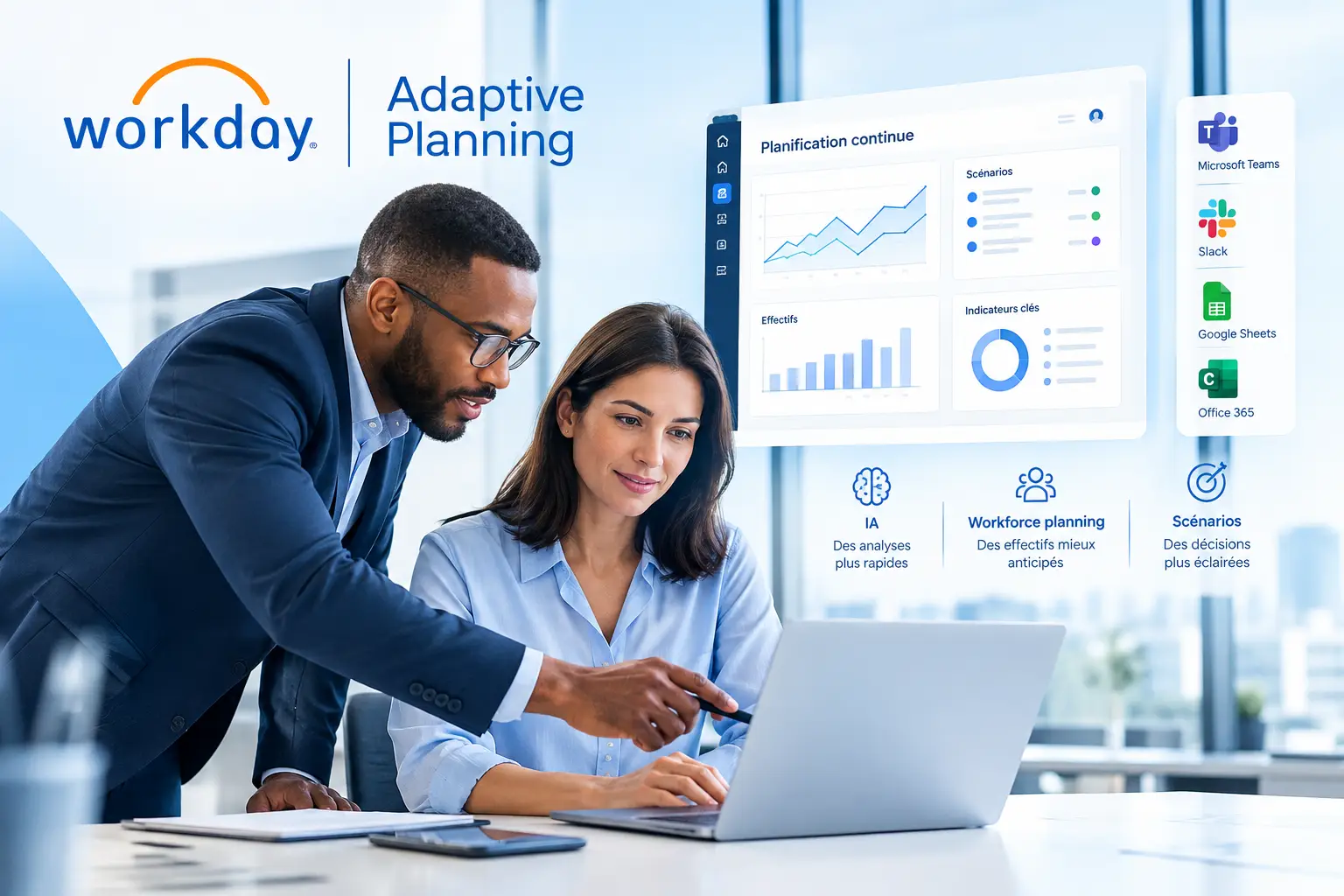
Workday also presents a Planning Hub designed to centralize planning models, reports and dashboards. The idea is to give teams a shared space for accessing the various elements required for their work.
The solution also offers connections with tools already used on a daily basis. Notifications can notably be sent via Microsoft Teams and Slack, while integration with Google Sheets makes it possible to continue certain operations in the spreadsheet environment.
Workday also maintains its integration with the Office environment through Office Connect, enabling users in particular to work on reports and analyses from Excel on Mac and Windows.
Continuous planning
Beyond individual features, Workday advocates an evolution of the planning model. Continuous planning consists of regularly updating forecasts and scenarios rather than relying solely on budgeting exercises carried out at fixed intervals.
For financial departments, this approach can help bring forecasts closer to developments observed in the field. However, it requires an appropriate organization, sufficiently reliable data and effective coordination between the company’s different functions.
Workday also points out that some features presented in this new generation may correspond to announced products or services that are not yet generally available. Their availability and characteristics may therefore still evolve.
With this evolution of Workday Adaptive Planning, the provider is positioning AI, simulation and collaboration as components of enterprise planning. The challenge now is to see how these capabilities will be adopted by organizations and integrated into their financial and operational processes.
source: Workday