What will the CFO of tomorrow look like?
Will they be replaced by artificial intelligence, capable of automatically producing analyses, building forecasts and identifying trends? Will they still spend their days consolidating Excel files, reconciling different versions of the same indicator or producing ever-increasing numbers of reports?
Probably not.
The finance function is undergoing one of the most profound transformations in its history. Long perceived as the guardian of figures and financial compliance, the Chief Financial Officer now occupies a much more strategic position.
The succession of economic, health, energy and geopolitical crises has profoundly changed the expectations of executive teams. In an environment where economic cycles are shorter, markets evolve rapidly and uncertainty has become permanent, managing solely on the basis of past results is no longer sufficient.
The CFO of tomorrow will no longer be merely the person who explains what has happened.
They will be the person who helps the company decide what to do next.
The role of the finance function is undergoing a major transformation. The CFO’s value will no longer lie solely in their ability to produce reliable information, but in their ability to turn that information into strategic decisions.
“Finance functions are gradually moving from a reporting mindset to one focused on anticipation and performance management,” notes Laurence Yvon, Sales Development Director at Amelkis.
A Strategic CFO: Moving from Reporting to Anticipation
Historically, a significant proportion of finance teams’ time was devoted to producing information.
Collecting data, checking its consistency, consolidating figures and preparing reports: all essential steps, but ones that often limited the time available for analysis.
Yet the value of finance does not lie in producing the figure.
It lies in its ability to give that figure meaning.
Executive teams now expect their CFO to be able to respond quickly to much more complex questions:
What happens if our costs increase by 10%?
What will be the impact of a change in exchange rates?
Should we accelerate or postpone an investment?
How can we quickly integrate a new acquisition into our performance management?
Which scenario should we favour depending on market developments?
In this context, traditional budgeting processes are showing their limitations. Building a fixed annual budget over several months increasingly fails to reflect the economic reality of companies.
Financial performance management is gradually evolving towards more dynamic models: rolling forecast, multiple simulations, continuous reforecasting.
The CFO thus becomes a true strategic copilot capable of informing the decisions of the executive committee.
A CFO Augmented by Artificial Intelligence, Not Replaced by It
The arrival of generative artificial intelligence marks a new stage in this transformation.
As is often the case with technological breakthroughs, it generates as much enthusiasm as it does questions.
Yet the challenge is probably not to replace finance teams, but to fundamentally transform the way they work.
Artificial intelligence can already automate certain time-consuming tasks: consistency checks, anomaly detection, analysis of large volumes of data and generation of initial financial commentary.
Tomorrow, it will go even further: detecting weak signals, proposing alternative scenarios and identifying correlations invisible across several dimensions of the business.
But AI knows neither the company’s strategy, nor its history, culture or priorities.
It brings analytical power.
The CFO brings judgment.
It is this combination of technology and human intelligence that will give rise to a new generation of finance professionals: augmented finance professionals.
An Architect of Data and Trust
The multiplication of data represents a tremendous opportunity today, but also a new challenge.
Never before have companies had access to so much information: commercial, industrial, HR, financial, ESG and supply chain data…
Yet many organisations still face a major difficulty: turning this abundance of data into a clear, shared view.
How many meetings still begin with a debate about the reliability of the figure rather than the decision to be made?
Why do several departments sometimes have different versions of the same indicator?
How can we ensure that an international group and its subsidiaries are working from the same reality?
The CFO of the future will play an essential role in this governance.
They will become the architect of reliable, structured and shared data: a “single source of truth” enabling the entire company to make decisions on a common basis.
Finance thus becomes a common language across the business.
A Business Partner Connected to Operations
Being a business partner no longer simply means producing reports for operational teams.
It means understanding their challenges, speaking their language and building the best scenarios with them.
The modern CFO must connect the company’s strategic objectives with on-the-ground reality.
This evolution is profoundly changing the relationship between central teams and subsidiaries.
The challenge is no longer to impose a uniform performance management model, but to find the right balance: providing a common framework robust enough to ensure group-wide consistency, while giving local teams the agility they need to manage their business.
Structure without constraining.
This is probably one of the major challenges facing finance functions of the future.
The CFO of Tomorrow: More Human, More Strategic, More Influential
Contrary to certain preconceptions, technology does not diminish the importance of the finance role.
It elevates it.
By progressively automating low-value-added tasks, it enables finance teams to focus on what really matters: analysing, challenging, advising and supporting decision-making.
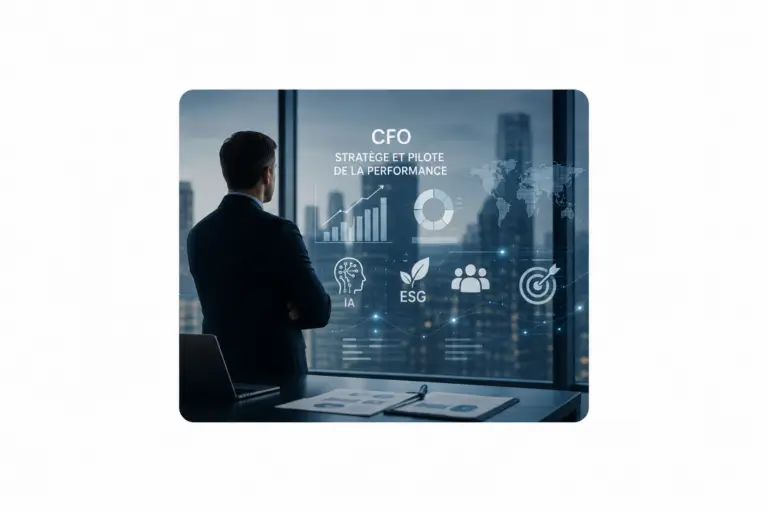
The CFO of the future will therefore be hybrid:
Financial expert,
strategist,
data specialist,
business partner,
driver of sustainable transformation.
Their main challenge will no longer be merely to guarantee the reliability of the past.
It will be to help the company build its future.
At Amelkis, we are convinced that this new generation of finance functions will need environments capable of connecting consolidation, performance management, ESG and artificial intelligence.
Because tomorrow, performance will no longer depend solely on the amount of data available.
It will depend on companies’ ability to quickly turn that data into decisions.